
Delivering Value at the Flip of a Switch
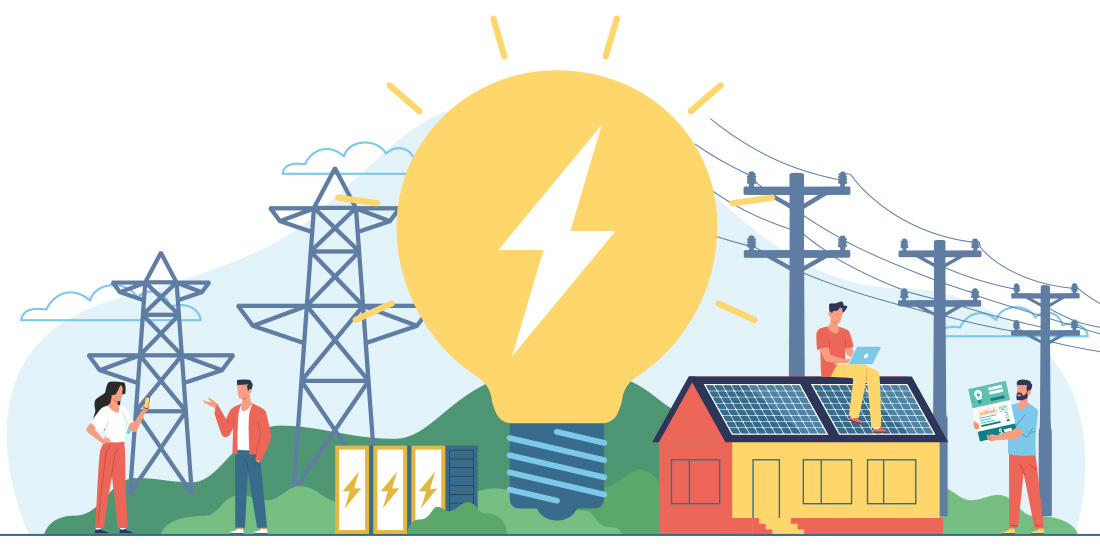
In a world where inflation has increased the cost of nearly everything, Members still get value when they flip on the lights. This is just one of the many ways in which being a cooperative sets us apart from the for-profit utilities in North Texas.
This year, we will dig deeper into your bill, explaining what each component means, what parts of it we can control and what parts we don’t.
The three main costs on your electric bill are:
- Energy costs
- Transmission costs
- Distribution costs

Energy Costs
55-60% of the total cost of your bill.
Energy costs are the largest portion of your bill. Energy costs reflect the wholesale cost of
buying electricity from generators in the Electric Reliability Council of Texas (ERCOT) market.
In ERCOT, the wholesale price of electricity fluctuates in real time based on supply and demand. Demand represents how much electricity all the customers in ERCOT are using right now, at a specific moment rather than over a set time period. Wholesale prices generally increase as demand gets higher.
If demand gets so high that it approaches the total amount of available generation, leaving only a small amount of excess generation available to handle demand fluctuations, then the market is said to be in “scarcity.” ERCOT real-time wholesale prices can be extremely high when scarcity happens. For example, if demand is high on a hot day because of air conditioning use, and a large generator trips offline, then prices increase because only a small amount of excess generation remains to handle demand fluctuations.
To minimize the potential impact of high scarcity prices, which we can’t control, CoServ’s Energy Resources Team makes strategic decisions to buy blocks of power days, months, and even years ahead of time. These long-term purchases are made assuming normal weather conditions. As we get closer to the time the energy will be delivered, we make additional purchases or sell excess energy based on forecasts of actual weather.
Buying power in advance shields Members from big price spikes that can occur in the real-time market, especially on extremely cold or hot days.
The cost to procure energy delivered to our members is a pass-through. CoServ accounts for fluctuations in wholesale electricity prices by adjusting the Power Cost Recovery Factor (PCRF) each month.

Transmission Costs
15-20% of the total cost of your bill.
Transmission costs reflect the cost of high-voltage transmission lines that transmit electricity from the generators to CoServ, a journey that could be hundreds of miles. Transmission costs are the smallest of the three main cost components on your bill, but these costs have been increasing significantly over the past several years as Texas builds more transmission capacity.
Each year, ERCOT allocates transmission costs to all energy providers based on Coincident Peaks (CP), the measure of a utility provider’s demand at the same time the ERCOT grid reaches its highest overall demand during each month from June through September. At the end of the month, the 15-minute interval where ERCOT has the highest demand is the CP for that month, and CoServ’s transmission cost is calculated based on our share of the total ERCOT peak. Reducing energy use during that critical 15‑minute interval, typically in the late afternoon, can help lower CoServ’s transmission costs.
Like energy costs, transmission costs are pass‑through costs included in the PCRF. We use weather and load forecasts to determine when the CP is most likely to happen and utilize our demand response programs, such as PeakTime Perks, to help shave megawatts off the CP. Ultimately, this helps reduce the transmission component of your bill.

Distribution Costs
25-30% of the total cost of your bill.
Substations are located at the end of transmission lines to reduce the electricity voltage to more moderate levels, and electricity is then distributed locally to homes and businesses. The costs for this local distribution system are the second largest component of your bill, and they are the only costs that CoServ directly controls.
CoServ’s distribution system consists of wood and concrete poles, overhead wire, underground conduits, transformers, switch gears, and other equipment that distribute electricity from the substation and safely deliver electricity to your home, business, or school. It also includes distribution automation equipment that helps prevent long-term outages and enables CoServ to continuously monitor the network.
CoServ strives to effectively manage its distribution system to ensure both low costs and high reliability. This includes maintaining sufficient inventory to be able to respond quickly to outages and support new development. These steps have been especially critical lately when nationwide electric growth and tariffs have caused some equipment to be in short supply. CoServ has worked with its materials supplier to diversify manufacturers that can meet system requirements while helping offset tariff impacts.
In the months ahead, we’ll take a closer look at what powers your bill — with deep dives into Energy in June, Transmission in July, and Distribution in August.