
The Price of Power: Beyond Your Local Grid, Transmission Costs Explained
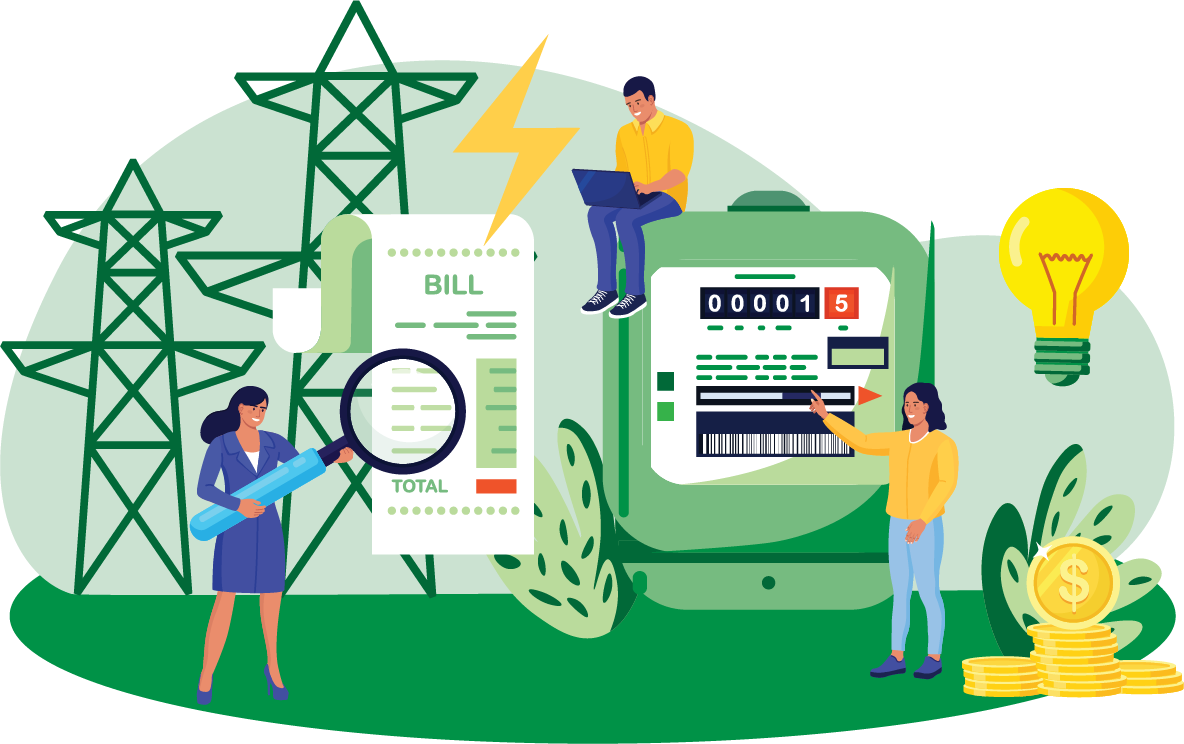
TRANSMISSION COSTS account for about 15–20% of your CoServ electric bill and are affected by two main factors: coincident peak (CP) demand and statewide capital projects.
We’ll break them both down for you in the second installment of our Pricing Series and explain what we can and can’t do to help lower this cost.
What is Coincident Peak (CP)?
To distribute transmission costs fairly, the Electric Reliability Council of Texas (ERCOT) calculates transmission costs for CoServ and other utilities based on each utility’s Coincident Peak (CP), the measure of the utility’s total demand at the same time the ERCOT grid reaches its highest overall demand. ERCOT then averages each utility’s CP values from June through September to set that utility’s share of overall transmission costs for the following year. The lower the utility’s demand during those peak moments, the lower its costs.
Another way to think about this is like a pie that must be shared. Each utility’s slice is based on how much demand they have at those peak moments (the CP). For CoServ, a smaller “slice” means a smaller share of the total cost and ultimately lower costs for our Members down the line.
While it’s impossible to know when the CP will occur in the moment, CoServ can leverage demand response programs to reduce demand and potentially reduce our CP.
How Demand Response Programs Help Reduce Costs
CoServ offers several demand response programs to reduce electricity use during high-demand periods, including thermostat programs like Rush Hour Rewards and battery-based options like Tesla Powerwall and Base Power. Together, these programs lower the total electricity use from our Members when demand is highest, helping reduce CoServ’s share of the Coincident Peak and transmission costs.
“Whether it’s adjusting a smart thermostat or using a battery to help ease grid strain, these demand response initiatives are CoServ’s way of helping to reduce our transmission costs and ultimately, save our Members money,” said CoServ’s President and CEO, Donnie Clary.
Transmission Costs We Can't Control: Statewide Capital Projects
Highways are built to accommodate peak rush hour traffic. We may not need three or four lanes at 10 a.m., but you certainly need them at 5 p.m.
Transmission lines follow the same principle.
The transmission system must be built with enough capacity to meet peak demand when it’s needed most. That’s why growth is the largest contributing factor to cost increases as new transmission lines are built across the state.
The electricity powering your home or business can travel hundreds of miles across the Electric Reliability Council of Texas (ERCOT) grid before reaching CoServ, passing through multiple transmission systems along the way. Since all Texans on the grid benefit from this shared network, the cost of new transmission lines is spread across the state. This means all utilities, including CoServ, are impacted by these costs. To reference the previous analogy, the size of the overall pie is getting bigger.
A recent study by the Texas Public Policy Foundation estimated that ERCOT transmission costs increased by 57% from 2010 to 2024. The main driver of this increase was the Competitive Renewable Energy Zones (CREZ) project, which connected generation resources in West Texas to Central and East Texas.
Now, Texas is facing another set of long-distance transmission line projects, which will bring more cost increases to utilities and their customers. While we can’t change these cost increases, we do actively monitor these projects and closely review how costs are allocated to help protect our Members and ensure you only pay your fair share.
“While some transmission costs are beyond our control, every action we take—from managing peak demand to reviewing statewide projects—is focused on protecting our Members and keeping costs as low as possible,” Donnie said.
Transmission Costs At-a-Glance
What are transmission costs?
Transmission costs pay for the high voltage power lines that move electricity across Texas from generators to local utilities like CoServ.
Who sets transmission costs?
Transmission costs are set by ERCOT and transmission providers, not CoServ.
Does CoServ markup transmission costs?
No. Transmission costs are pass through costs, meaning Members pay what CoServ is charged — no markup.
What affects transmission costs?
- Coincident Peaks (CP): the 15-minute periods when ERCOT demand is highest during summer months.
- How much electricity CoServ is using at the same time during those peak events
- Long term investment in new transmission lines across Texas
How does CoServ help control transmission costs?
- Using weather and load forecasts to anticipate peak periods
- Reducing demand during critical peak intervals
- Using demand response programs to help lower peak demand