What to Expect on Your December Bill

Temperatures were all over the place in November with a low of 35 degrees on November 10 and a high of 89 degrees just five days later.
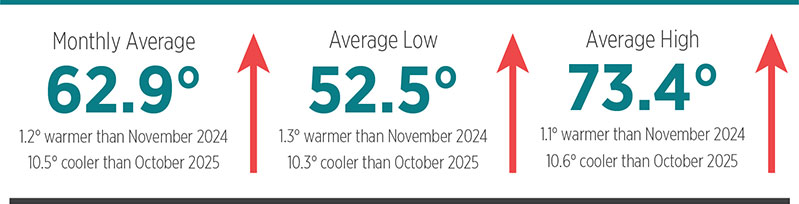
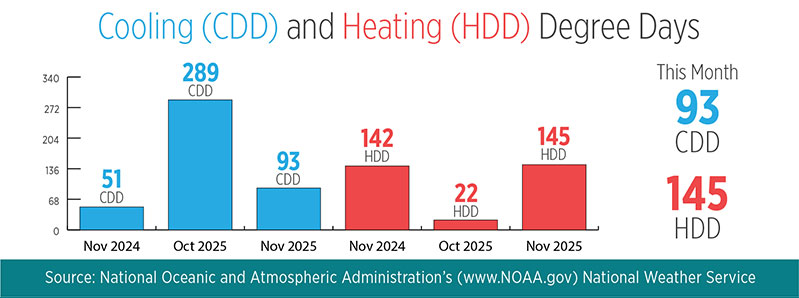
Members should expect November 2025 consumption to be similar or slightly less compared to the same period last year. While there were 11 days where the high topped 80 degrees, the average temperature for November was 10.5 degrees less than the previous month. Members should expect energy usage to be less compared to the previous month because less air conditioning was needed. Heaters made their first appearance of the season in November, too, but it was only needed on a few days as the graph below shows.
| October | November | Difference | |
|---|---|---|---|
| Average temperature | 73.4 | 62.9 | 10.5 degrees cooler |
| Heating Degree Days | 22 | 145 | 123 more HDD |
| Cooling Degree Days | 289 | 93 | 196 less CDD |
| Utilities and the federal government measure the impact of weather on energy usage by calculating Cooling Degree Days (CDD) and Heating Degree Days (HDD). To calculate the CDD, take the average temperature for a day and subtract it from 65. The higher the number, the more air conditioning will be needed to keep your home comfortable. Click here for more information on calculating CDD. | |||
The closer the average temperature is to 65 degrees, the less energy that’s needed to cool or heat an indoor space.
Winter really took hold on Thanksgiving weekend at the end of the month. By calculating the HDD, you can see the impact a cold snap like the one on Nov. 30 can have on energy usage. It can be just as impactful as the hottest summer day. For example, the average temperature for Nov. 30 was 38.5. Subtracting from the baseline temperature of 65, that’s 26 HDD. By comparison, the hottest days in July (July 31) and August (Aug. 19) had average temperatures of 91.5 degrees so the CDD was 27.
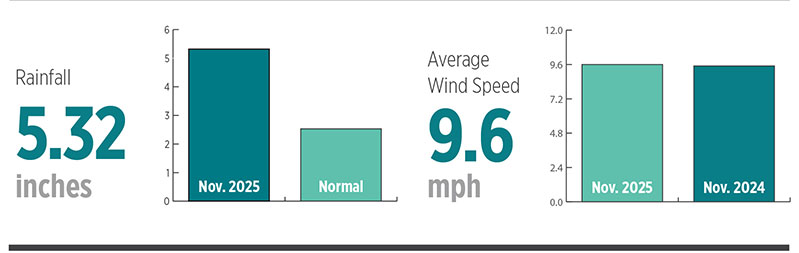
November started out dry with only a trace of rain on Nov. 1 and not a single drop detected until Nov. 20, when a deluge dumped almost 4 inches in a single day. North Texas finished the month with 5.32 inches of rain, nearly twice the normal amount.
RATES
While predicting the weather might be difficult, CoServ works hard every day to keep electricity rates consistent and affordable for Members.
We do that by making strategic wholesale electricity purchases months and years ahead of time to lock in affordable prices. As an electric co-op, when we save money, we pass that on to you, as we did this month.
For December billing, the Standard residential rate will be 11.31 cents per kilowatt hour, the same rate as November. For CoServ, it’s the lowest rate since the summer of 2023.
CoServ accounts for fluctuations in wholesale prices by adjusting the Power Cost Recovery Factor (PCRF). For December billing, the PCRF will be a negative -0.015. A negative PCRF subtracts from the base rate, lowering electric costs.
This marks the 18th straight month where CoServ PCRF is negative.
Click here to learn more about how your CoServ rate is calculated.
Click here to compare our rates to the average retail electric provider in North Texas.