What to Expect on Your June Bill

May started out cool, with average temperatures in the 60s and 70s, meaning North Texans could give their thermostats a bit of a break. By mid-May, the weather started feeling more like early summer should with highs in the low 90s.
By late May, summer had settled in with highs in the mid-90s, meaning air conditioners were going full power to keep indoor spaces cool.
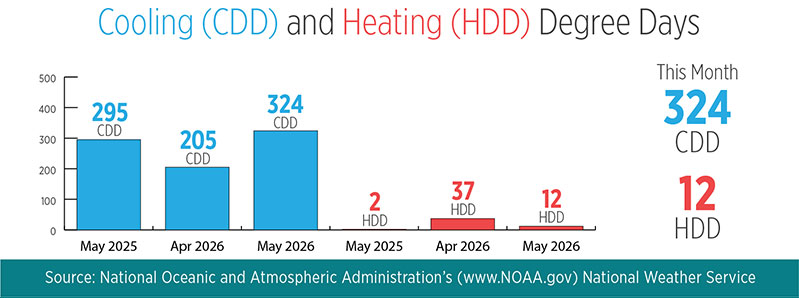
CoServ Members should expect May electricity usage to be higher than April because of a 58% increase in Cooling Degree Days.
| April | May | Difference | |
|---|---|---|---|
| Average temperature | 70.3 | 74.8 | 4.5 degrees warmer |
| Heating Degree Days | 37 | 12 | 25 less HDD |
| Cooling Degree Days | 205 | 324 | 119 more CDD |
| Utilities and the federal government measure the impact of weather on energy usage by calculating Cooling Degree Days (CDD) and Heating Degree Days (HDD). To calculate the CDD, take the average temperature for a day and subtract it from 65. The higher the number, the more air conditioning will be needed to keep your home comfortable. Click here for more information on calculating CDD. | |||
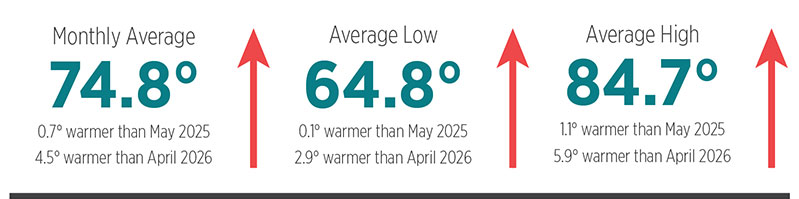
The average temperature for May was 74.8 degrees, 4.5 degrees warmer than April. The average high temperature was 84.7, almost 6 degrees warmer than April.
High and low temperatures were all over the spectrum with a low of 50 degrees on May 2 and a high of 95 degrees on May 31. In total, there were 9 days where temperatures hit 90 degrees or higher. There were 7 nights with temperatures at 60 degrees or lower.
The warmest May in recent years occurred during the heat wave of 2022 when there were 20 days with highs of 90 degrees or more. The Cooling Degree Days were 26% higher for May 2022 compared to May 2026. Members may remember having higher electricity usage not just that month but throughout that summer.
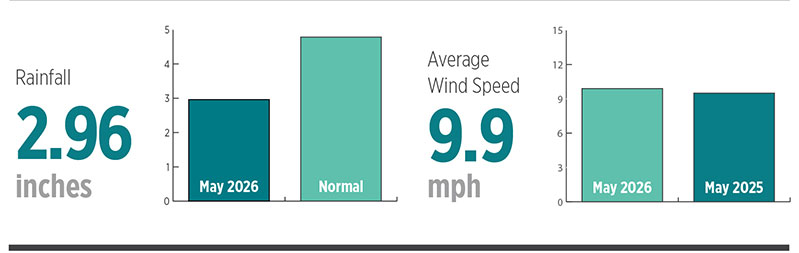
For May 2026, it rained almost 3 inches, including a May 10 storm that dumped 1 inch. Despite the persistent storms, the total rainfall was still 1.8 inches below normal.
RATES
Temperatures are rising, but CoServ’s electricity rates stayed the same this month.
For June billing, the Standard residential rate will be 12.18 cents per kilowatt-hour.
The Power Cost Recovery Factor (PCRF), which accounts for fluctuations in wholesale electricity prices, will be negative for the 24th straight month. The PCRF is -0.006 per kilowatt-hour, meaning it subtracts from the energy rate to true up to CoServ’s actual power cost, not just for May but anticipating the cost in future months.
CoServ’s goal is to provide exceptional electric service to Members at an affordable cost. Click here to see how we stack up against for-profit retail electric providers in Texas.
Click here to learn more about how your CoServ electric rate is calculated.