What to Expect on your February Bill
For three weeks, January cruised along with mild temperatures, including two days with a high of 80 degrees.
Then Winter Storm Fern arrived on Jan. 22.
Over the next nine days, temperatures dipped as low as 13 degrees while snow, ice pellets and sleet turned streets and sidewalks into skating rinks.
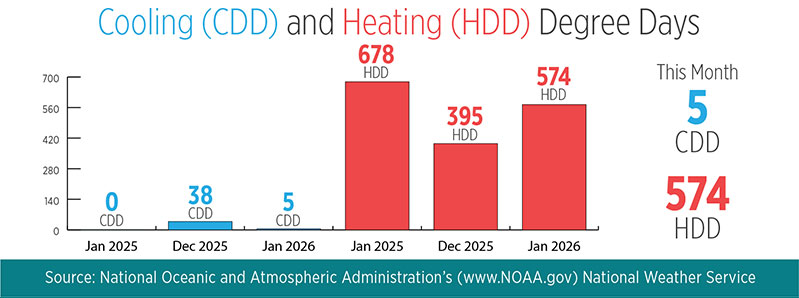
The Heating Degree Days (HDDs) directly attributed to Winter Storm Fern and its aftermath were 317, more than half the HDD for the entire month. CoServ Members should expect energy usage and their bills to be higher compared to December.
| December | January | Difference | |
|---|---|---|---|
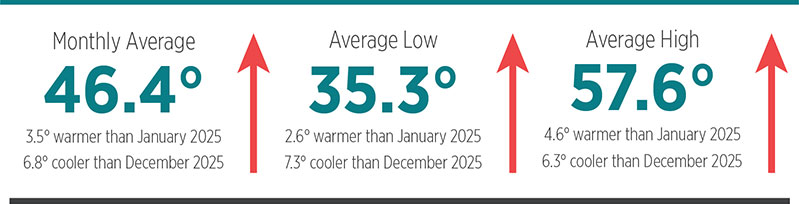
| Average temperature | 53.2 | 46.4 | 6.8 degrees cooler |
| Heating Degree Days | 395 | 574 | 179 more HDD |
| Cooling Degree Days | 38 | 5 | 33 fewer CDD |
| Utilities and the federal government measure the impact of weather on energy usage by calculating Cooling Degree Days (CDD) and Heating Degree Days (HDD). To calculate the CDD, take the average temperature for a day and subtract it from 65. The higher the number, the more air conditioning will be needed to keep your home comfortable. Click here for more information on calculating CDD. | |||
If you have an electric heater, the increased usage will be reflected in your electric bill. Homes with gas heaters will have increased gas usage for January, while electric usage could decrease.
While Winter Storm Fern is fresh on people’s minds, it’s important to note that the mild temperatures in the first half of the month skewed the numbers for the month overall. The average temperature for January 2026 was 46.4 degrees, which is 3.6 degrees higher than the average for January 2025. Some Members may have even turned on their air conditioners at some point. That’s why the HDDs were 18% less for this January compared to the same month last year. That means, despite Winter Storm Fern, energy usage could be less this January than last January, when we had more consistently cold days.
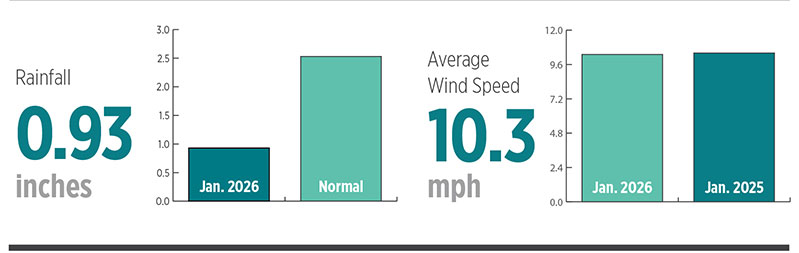
January continued the drought conditions that have been ongoing for several months now. There was hardly any measurable rain for the first three weeks. Winter Storm Fern brought nearly an inch of precipitation and a total of 2.4 inches of snowfall. That’s still about an inch and a half below normal rainfall totals.
RATES
While temperatures jumped around from 80 degrees all the way down to 13 degrees, CoServ’s electric rates remain consistent.
For February billing, the Standard residential rate will be 11.28 cents per kilowatt-hour, the same rate as last month.
The Power Cost Recovery Factor (PCRF), which accounts for fluctuations in wholesale electricity prices, will also remain the same. For February billing, the PCRF will remain at -0.015 cents per kilowatt-hour. A negative PCRF subtracts from the base rate, lowering electric costs for Members.
This marks the 20th straight month that the PCRF has been negative. As an electric co-op, when we save money, we pass that on to you, as we did this month.
Click here to learn more about how your CoServ electric rate is calculated.
Click here to compare our rates to the average retail electric provider in Texas.