What to expect on your March bill

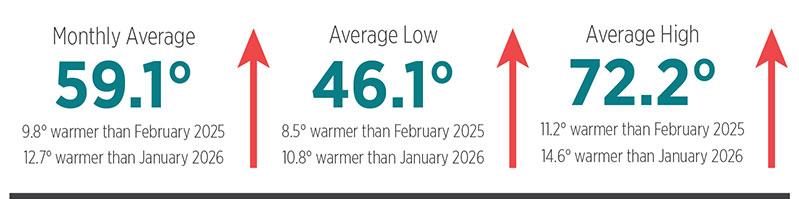
The last remnants of Winter Storm Fern gave a chilly start to February with lows in the 20s on Feb. 1, but it didn’t last. By Feb. 2, the highs were in the 70s, and the mild winter of 2025-2026 continued.
In fact, this February was the warmest since 2017.
| January | February | Difference | |
|---|---|---|---|
| Average temperature | 46.4 | 59.1 | 12.7 degrees warmer |
| Heating Degree Days | 574 | 179 | 395 less HDD |
| Cooling Degree Days | 5 | 25 | 20 more CDD |
| Utilities and the federal government measure the impact of weather on energy usage by calculating Cooling Degree Days (CDD) and Heating Degree Days (HDD). To calculate the CDD, take the average temperature for a day and subtract it from 65. The higher the number, the more air conditioning will be needed to keep your home comfortable. Click here for more information on calculating CDD. | |||
There were 14 days with average temperatures in the 60s. From an energy standpoint, that’s the sweet spot where CoServ Members don’t have to use air conditioning or heating.
That means CoServ Members and Customers should have lower energy usage this month compared to January. This February was almost 10 degrees warmer on average than the same period last year, so CoServ Members and Customers should expect energy usage to be less.
By Feb. 8, temperatures felt more like early summer than winter with highs in the 80s.
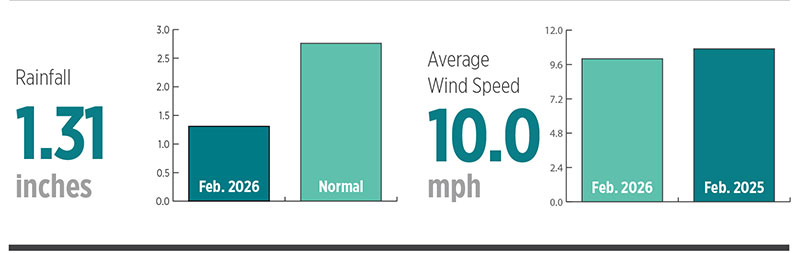
February was also dry, with nearly all the precipitation coming on Valentine’s Day.
RATES
Regardless of what the weather does, CoServ Members can count on their electricity rate to remain consistent.
For March billing, the Standard residential rate will be 11.28 cents per kilowatt-hour, the same rate as last month.
The Power Cost Recovery Factor (PCRF), which accounts for fluctuations in wholesale electricity prices, will also remain the same. For March billing, the PCRF will remain at -0.015 cents per kilowatt-hour. A negative PCRF subtracts from the base rate, lowering electric costs for Members.
This marks the 21st straight month that the PCRF has been negative. As an electric co-op, when we save money, we pass that on to Members, as we did this month.
Click here to learn more about how your CoServ electric rate is calculated.
Click here to compare our rates to the average retail electric provider in Texas.