What to expect on your September bill

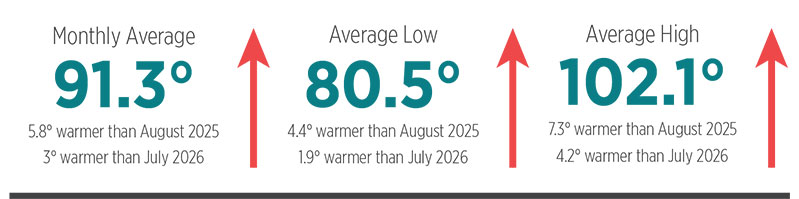
August 2026 was the third hottest August on record this century in North Texas, with highs of 109 on Aug. 23 and 24. The average low was just 80.5 degrees, according to the National Weather Service.
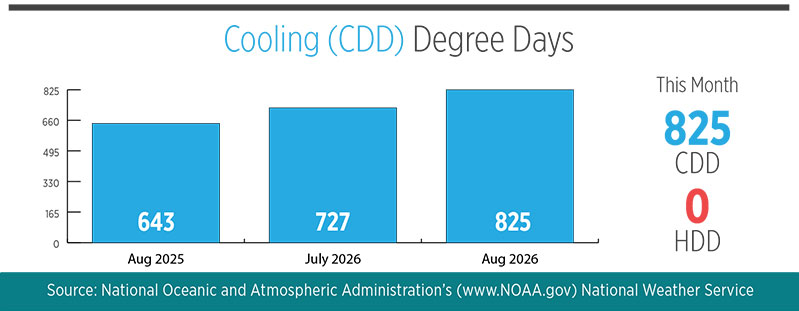
Needless to say, electricity usage for August will be higher compared to the prior month, based on the Cooling Degree Days, which are explained below. However, CoServ Members will pay less per kilowatt-hour this month compared to last month. See Rates below for more on that.
This most recent August wasn’t close to how hot it was in 2023 (CDD of 872) or the record holder for the century so far, 2011 (CDD of 887). Even July 2022 and 2011 were slightly hotter (CDD of 838 and 828, respectively).
| July | August | Difference | |
|---|---|---|---|
| Average temperature | 88.3 | 91.3 | 3 degrees warmer |
| Heating Degree Days | 0 | 0 | 0 |
| Cooling Degree Days | 727 | 825 | 98 more CDD |
| Utilities and the federal government measure the impact of weather on energy usage by calculating Cooling Degree Days (CDD) and Heating Degree Days (HDD). To calculate the CDD, take the average temperature for a day and subtract it from 65. The higher the number, the more air conditioning will be needed to keep your home comfortable. Click here for more information on calculating CDD. | |||
August 2026 was warmer than July by a total of 3 degrees on average. Highs reached 100 degrees on 27 days and there were 22 nights at 80 degrees.
The average temperature for August was 91.3 degrees, 5.8 degrees hotter than the average temperature for the same period in 2025. The average high temperature was 102.1 degrees, 7.3 degrees warmer than the average high in August last year.
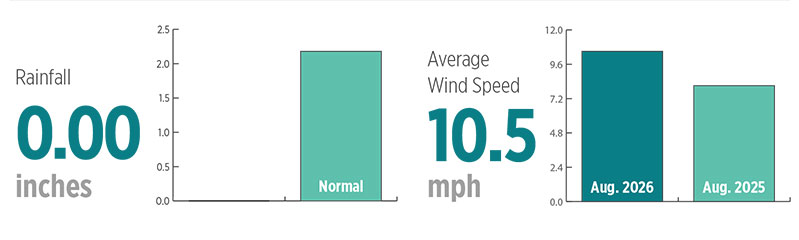
The drought also continued in North Texas with zero recorded rainfall at Dallas-Fort Worth International Airport. Some areas of North Texas did receive spotty showers with rain, though.
RATES
While temperatures were almost unprecedented, CoServ continues to make strategic, advanced power purchases to keep electricity costs down, and that’s reflected on this month’s bill.
For September, the Standard residential rate will be 11.78 cents per kilowatt-hour, a half cent lower than last month.
That’s because CoServ adjusted the Power Cost Recovery Factor (PCRF) from -$0.005 to -$0.01. The PCRF accounts for fluctuations in wholesale power cost, so when we save money, we pass that on to Members, as we did this month. The PCRF will subtract 1 penny off all electricity rates this month.
One reason we’re able to do that is because we buy electricity in advance to lock in the price, rather than being exposed to high prices in the real-time market.
Click here to see how we stack up against for-profit retail electric providers in Texas.
View the What Powers Your Bill webpage for more in-depth information on what goes into calculating your bill.
Click here to see all of CoServ’s residential electric rates.