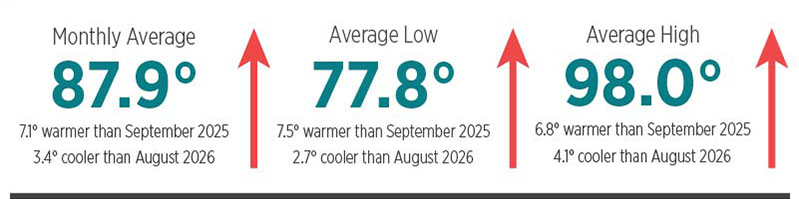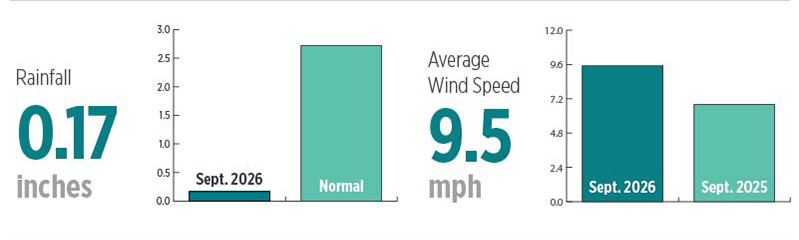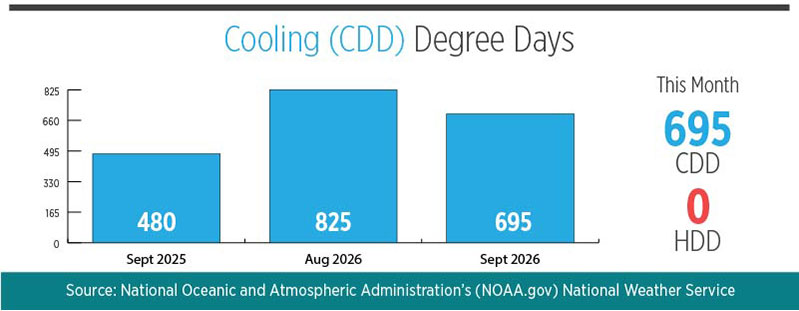
This past September was brutally hot with half the days reaching highs of 100 degrees or higher. Adding up the Cooling Degree Days (CDD) for the month, it was the highest number recorded for any September this century. See the chart below for more data.
| August | September | Difference | |
|---|---|---|---|
| Average temperature | 91.3 | 87.9 | 3.4 degrees cooler |
| Heating Degree Days | 0 | 0 | 0 HDD |
| Cooling Degree Days | 825 | 695 | 130 less CDD |
| Utilities and the federal government measure the impact of weather on energy usage by calculating Cooling Degree Days (CDD) and Heating Degree Days (HDD). To calculate the CDD, take the average temperature for a day and subtract it from 65. The higher the number, the more air conditioning will be needed to keep your home comfortable. Click here for more information on calculating CDD. | |||
CoServ Members should expect electricity usage to be higher this month compared to last year. In fact, CoServ’s average residential usage soared to 2,239 kilowatt-hours, higher than any single month – not just September – in the last three years.
September's average temperature was 87.9 degrees, 7.1 degrees warmer than the same month last year. Even after sunset, temperatures stayed unusually warm, with eight nights never dropping below 80 degrees. Daytime highs hit 102 degrees on Sept. 7, 8, and 12.
RATES
We know some CoServ Members might be shocked by their September usage, but there’s some good news, too. Once again, CoServ has lowered your cost per kilowatt-hour by adjusting the Power Cost Recovery Factor (PCRF).
For October billing, the Standard residential rate will be 11.48 cents per kilowatt-hour, one-third of a penny lower than last month.
The PCRF was adjusted from -$0.01 to -$0.013. This is the second month in a row that the PCRF has been adjusted. The PCRF accounts for fluctuations in wholesale power cost and ensures over time that we only collect what we need for the true cost of power.
One reason we’re able to do that is because we make strategic electricity purchases days, months and even years ahead of time. By locking in the price of power, we can avoid the volatility in the real-time market.
Want more information?
- See how we stack up against for-profit retail electric providers in Texas.
- View the What Powers Your Bill webpage for more in-depth information on what goes into calculating your bill.
- See all of CoServ’s residential electric rates.